ChatGPT for Pharma: What's Actually GxP-Safe (and What Isn't)
You're here for one of three reasons. Someone told you "we don't use AI" and you want to know whether that's a real rule or a fantasy that "not using AI" is still a selling point. Or you've been using it (stealthily) for months and want to know your actual exposure. Or you're the one who has to write the policy, and every article you've found raises questions without answering a single one.
This guide is intended to give you clarity: What is Safe, Safe with a condition, or No, with the reasoning attached. I've been working with quality assurance and regulatory affairs professionals for over 15 years and have been providing AI upskilling sessions to life science professionals since the technology emerged. I understand what a fundamental shift this is having on the industry and how we all can benefit from the speed, accuracy, and depth of analysis these remarkable tools can achieve, and I hope to share this knowledge with anyone ready to get started. I also want everyone to stay out of trouble, so here we go.
The three-zone rule
Almost every ChatGPT-and-GxP question points to one underlying question: where does the AI reside relative to your GxP processes? There are three answers, and each comes with its own rulebook.
Zone 1 — Adjacent to GxP. You're using AI to understand, learn, or explore: summarizing a published guidance, getting oriented in a new therapeutic area, rehearsing for a meeting. Nothing the AI produces touches a regulated record. This is the freedom zone, so go nuts.
Zone 2 — Feeding a GxP process. The AI produces a draft, an analysis, or a comparison that a qualified human reviews, corrects, and takes ownership of before it enters the quality system. The regulated artifact is the human-approved version. This zone is workable today with conditions, and it's where the real productivity gains can be found.
Zone 3 — Inside a GxP process. AI output becomes a record without independent human verification, or the tool itself performs a regulated function. This is the validation zone. It has legitimate uses, a real regulatory pathway, and a level of qualification work that most teams reading this page are not ready for and don't need to be.
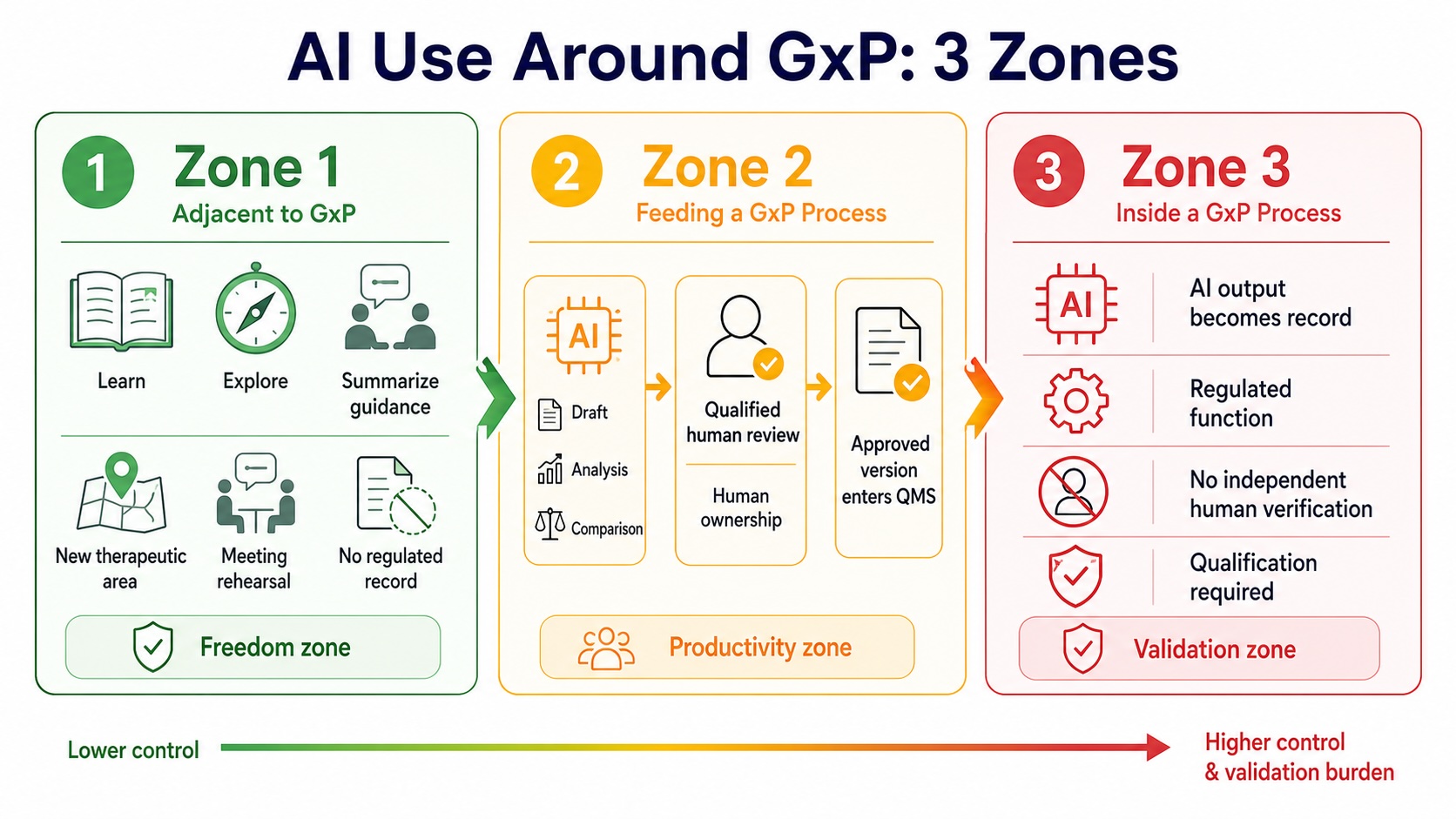
Keep the zones in mind as we continue.
Is ChatGPT GxP compliant?
Surprise, that's not the question that should be asked. Tools aren't compliant; uses are. Asking whether ChatGPT is GxP compliant is like asking whether Microsoft Word is GxP compliant — Word drafting an SOP is unremarkable, while Word auto-generating batch records nobody reviews would be a finding. The compliance question always attaches to the process around the tool: what goes in, who reviews what comes out, and who is accountable for the result.
So when a vendor tells you their AI is "compliant," they're describing their security certifications, which are necessary and useful and answer a different question. Whether your use (I call this the "last mile") is defensible depends on which zone you're operating in, which is something only you control.
Can I put company data into ChatGPT?
The verdict depends on two things: what kind of account, and what kind of data. Most of the risk difference people attribute to "AI" is between a personal consumer account and an enterprise deployment, and most new users have never checked which one they're on.
Consumer accounts (free or individual paid plans) are personal tools with personal-tool terms. Enterprise offerings (ChatGPT Enterprise, Team, and equivalents from other vendors) come with contractual commitments: your data isn't used for model training, admin controls exist, retention is configurable, and there's an actual agreement your company signed. The names of the tiers change often, but the idea of knowing which one you have will still be important.
The working matrix:
| Data type | Personal/consumer account | Company-approved enterprise account |
|---|---|---|
| Published, public information (guidances, regulations, papers) | Safe | Safe |
| Internal but non-sensitive (your own notes, generic process questions) | Gray — follow your company's policy, and if none exists, treat as "no" | Safe |
| Confidential company or product data | No | Safe, within the tool's approved scope |
| Patient data or personal data | No | Only if the deployment was explicitly assessed for it — assume no until shown otherwise |
The moment company information is involved, the account type becomes the compliance control. If your company has no approved enterprise tool, that's something to raise — it's a much more productive conversation than debating AI in the abstract.
What to document: nothing, for public information on any account. For everything else, your company policy decides, which is what the policy section below is for.
Does ChatGPT train on my data?
For free consumer accounts, assume yes by default: conversations can be used to improve models unless you've turned that off in your data settings. For enterprise and team offerings, the standard commitment is no training on your business data. Defaults and setting locations change within tools, so it's always a good idea to check periodically and when trying out a new tool.
Since defaults shift, verify yours right now rather than trusting what I just said: open your account's data or privacy settings and look for the model-improvement toggle, and if you're on a company deployment, ask whoever administers it to show you the data-processing terms. Two minutes, and you'll know instead of assuming.
One nuance worth knowing: training is a separate question from retention. A tool that doesn't train on your data may still retain conversation history according to its own schedule, which matters if you're pasting anything sensitive. Retention and data privacy terms live in the same enterprise agreement, which is one more reason the account type is the control that matters.
Can AI output go into a GMP document?
Yes — with the accountability condition, and it's non-negotiable. A qualified human reviews the content, corrects it, and takes ownership before it enters the quality system. Once that happens, the regulated artifact is the human-approved version, and the AI's involvement upstream is no different in kind from a colleague's rough draft or a template you started from.
This maps cleanly onto ALCOA+, which your quality system already speaks. Attributable means the accountable human, and it was never going to be the software. Accurate is established by the review, not by the generator. The audit trail attaches to the document from the point it enters your quality system, exactly as it always has — your 21 CFR Part 11 controls (or Annex 11, depending on your side of the Atlantic) govern the record and the system it lives in, not the drafting tool upstream of both. That's why this answer holds across GMP environments generally. Nothing about a first draft's origin changes the integrity requirements on the final record; what would change everything is skipping the review, because then you've drifted from zone 2 into zone 3 without any of zone 3's controls.
The practical standard, same as our RA guide teaches: treat AI output like a draft from a bright junior colleague. Nobody asks whether it's permissible for a junior colleague to write a first draft, and everybody understands the reviewer owns what gets signed.
What to document: whatever your policy says about AI-assisted drafting, and if you don't have a policy yet, note it as an open item rather than inventing per-document rules on the fly.
Does using AI require validation?
For zones 1 and 2, no. Validation applies to systems performing regulated functions, and in zones 1 and 2 the AI isn't performing one — the controlled process is the human review, which is already governed by your existing quality system. Requiring validation for a brainstorming or first-drafting tool would be like validating your whiteboard.
For zone 3, yes, genuinely and substantially: if AI output becomes a record without independent verification, or the tool performs a regulated function, you're in computerized-system territory with a risk-based qualification burden, plus an evolving set of regulator expectations specific to AI. None of this is truly settled, but that's a real path some companies are walking. It's also completely optional for capturing most of AI's value, which lives in zones 1 and 2.
This answer exists to kill the most paralyzing myth in the room, which is "we can't use AI until it's validated." That sentence assumes all AI use is zone 3, and it locks teams out of the two zones where no such requirement exists. Remember the zones!
What to document: for zones 1–2, nothing validation-related. Your policy's review requirements carry the load.
What will an auditor actually ask?
Auditors and QA reviewers are converging on a fairly predictable set of questions about AI use, and every one of them has a good answer if you've set yourself up honestly. Here's the conversation, question by question.
"Do you use AI in any GxP-related activities?" The bad answer is a nervous no that an inbox search would contradict. The good answer names your zones: "Yes — for drafting and analysis support. All output is reviewed and approved by qualified staff before entering the quality system; nothing AI-generated becomes a record without human verification." You better mean it too.
"Which tools, and under what terms?" Good answer: named tools, account tier, and the fact that an agreement exists. "Approved enterprise deployment, no training on our data, retention configured to X." If your honest answer today is "whatever accounts people personally signed up for," fix that before an auditor asks, because it's the one genuinely weak position on this list.
"How do you prevent confidential data going into unapproved tools?" Good answer: a policy that classifies data, an approved-tool list, and training records showing people actually learned the rules. Notice this is a data-governance answer and your data-governance program has a framework for it.
"How do you ensure the accuracy of AI-assisted content?" Good answer: the review requirement, stated as procedure. "AI output is treated as unverified draft material. Accuracy is established through documented review by qualified personnel, same as any other draft source."
"Is any AI performing functions without human review?" Good answer, for most readers: "No — we deliberately operate in draft-and-review mode only." If the answer is yes anywhere, that function needs the full zone 3 treatment, and you want to have discovered that yourself rather than during the audit.
Rehearse these five and you're better prepared than most of the industry. The pattern underneath them all is the same: know your zones, name your controls, and never claim less AI use than you actually have.
What should an AI use policy cover?
A workable AI use policy for a pharmaceutical company is shorter than people fear. Seven sections carry it:
- Scope — which tools, teams, and activities the policy covers
- Approved tools and tiers — named tools with account types, plus the rule for everything unnamed (default: not approved)
- Data classification rules — the matrix from earlier in this page, adapted to your data classes
- Zone definitions and boundaries — what's adjacent, what's feeding, what's off-limits without a validation decision
- Review requirements — who reviews AI-assisted content, and the standard it's reviewed against
- Documentation triggers — the short list of situations where AI use gets noted, and the explicit statement that zone 1 use requires none
- Training expectations — what people must understand before using the tools for work
The most common policy failure is writing only restrictions. A policy that never says "this is permitted, freely" teaches people the policy is an obstacle, and they route around it — which is how companies end up with the personal-account problem (shadow AI use) from the auditor section. It's important to write the permissions with the same care as the prohibitions.
Free template
Grab the AI Use Policy Skeleton
A ready-to-adapt Word document covering all seven sections above — scope, approved tools, data classification, zones, review, documentation, and training.
What about Copilot, Gemini, and Claude?
Everything on this page is tool-agnostic, because the zone logic and the account-tier logic don't care whose model is underneath. For any tool, ask the same three questions: what tier is this account and what do its terms commit to, which zone is this task in, and who owns the output before it touches the quality system.
Quick answers
Can I use my personal ChatGPT account on a work laptop? The laptop isn't the issue; the data is. Public-information tasks are fine anywhere. The moment company information is involved, personal accounts are out regardless of device, per the matrix above.
Can AI draft internal SOPs? Yes — classic zone 2. The draft is raw material, the review-and-approval workflow your document control system already enforces is the compliance mechanism, and the approved SOP is the record.
Do we have to disclose AI use in submissions? For AI-assisted drafting with full human review, current expectations generally treat it like any other authoring support. Where AI contributes to the science or the evidence itself, disclosure expectations are evolving — check the current guidance for your region and submission type.
Is it safe to summarize guidances with free AI tools? Yes — published guidance is public information, which makes this zone 1 on any account. It's also the single best way to build AI skill before you touch anything sensitive. Our practitioner's guide starts there: How to Use AI in Regulatory Affairs: A Practitioner's Guide.
Start with a policy that won't get in your team's way
Download the LabScale AI Use Policy Skeleton — the seven-section template built on everything in this guide.
Want workflows, fun rants, and AI news in your inbox every week?
Clear, practical takes on what matters for your CMC, QA, and regulatory work, once a week.
No spam. Unsubscribe anytime.
Want your whole team fluent, not just the enthusiasts?
That's what our team workshops are for — built around your workflows and compliance needs.
Explore workshops for teams →