New firm, BPI recap, and the "looks right" trap
This week I talk about speaking at BPI Boston this year and what I've been up to behind the scenes.
Hey friends!
It feels like forever since the last newsletter, and for that, I apologize. In my defense, it has been a wild few weeks.
I co-founded a new consulting firm, ARCBio Consultants! (Don’t worry, LabScale AI isn’t going anywhere) I instantly became ultra-mega busy with formation paperwork and all the general getting-up-and-running fun: a new website, email, tech subscriptions, the works. I'm still amazed at what a small team, or even a single person, can accomplish in very little time with the help of AI. This stuff would have taken weeks or even months just a few years ago. It's a perfect example of experts in all kinds of fields being able to do more of what they want than ever before, even outside of a large company. Like I always say, "what a time to be alive!"
The ink was barely dry on the business cards when I hit the road with my longtime boss/colleague Rick Stock to meet up with industry experts at BioProcess International in Boston. It was a fantastic event. I had the pleasure of speaking about organizational readiness for AI agent implementation, then sat on a panel discussing autonomous bioprocessing and what the future might look like once our data and autonomous systems finally get to where they need to be to take full advantage of this powerful technology. I'm so grateful to have shared the stage with everyone on that panel, and to have chatted with so many innovators on the conference floor!
Side note: Several attendees asked me for a copy of my slides afterward, so I've made them available for anyone who's interested. You can download them here.
Finally, I just wrapped up the latest AI Fundamentals Bootcamp for life science consultants, and I must say it was the best one yet! I'll be gearing up for the next cohort very soon, so if you or someone you know might be interested, send me a message on LinkedIn or shoot me an email. Here's a preview:
Four sessions, ~90 minutes, once a week
Session 1: LLM and Generative AI FUNdamentals (How does this crazy stuff work, and how did we get here?)
Session 2: AI Tool Safari (Take a tour of popular tools and dig around the settings and features…together!)
Session 3: Data Security and Responsible Use
Session 4: AI Adoption Strategy, Current Events + Controversies (because that's always fun!)
These bootcamps are just like they sound: a lot of info in a short amount of time, broken down for anyone who just doesn't know where to start.
So yes, it's been a whirlwind, but the AI news cycle certainly didn't take a vacation while I was busy! This week's edition is a little shorter than usual, but I didn't want to let another week go by without catching up. Here are a couple of stories that caught my eye.
Thanks for reading!
Alexa
News
Novo and Anthropic team up to bring Claude into drug discovery
What's New:
Novo Nordisk and Anthropic announced a collaboration on September 16 to speed up how Novo discovers and develops new medicines. Novo will use Anthropic's frontier models and Claude Science, Anthropic's science-focused offering, across R&D and for AI-assisted software engineering. Novo's CEO, Mike Doustdar, framed the deal as part of the company's goal to become the world's most AI-driven healthcare company. It builds on AI partnerships Novo already has with other technology companies.
How It Works:
The press release is light on technical specifics, but here's the outline:
Problem-first approach: Novo's scientists and computational teams will identify key drug discovery challenges. The two companies will then build targeted solutions for those specific workflows, with a focus on biological reasoning.
Start small, then scale: The first step is testing Claude Science on selected R&D workflows where the combined expertise is expected to have the biggest impact.
Software as an enabler: Novo will also use Anthropic's models for agentic software development, which it sees as key to scaling AI across the whole company, not just in the lab.
Guardrails built in: Both companies say the collaboration was designed with strong data governance and human oversight, in line with Novo's ethical and compliance standards.
Why it Matters:
AI is moving into scientific reasoning and into the software that runs the business, and both will eventually touch GxP-adjacent processes. Defined workflows, human review, and documented governance are the same things an inspector will want to see. The focus on internal software development also matters for CMC. Much of the friction in tech transfer, data integrity, and batch record review comes down to legacy systems and custom tools that AI-assisted engineering could help modernize much faster.
My Take:
The headline makes it sound all about “drug discovery” but no no, I’m tracking the software part. Using AI to build other tools for within the organization is (at least for now) the way to go, and I’ve thought that for a long time. This could be an excellent example of how companies need to be changing their entire way of thinking about how things should get done (from tasks to systems). So yes! Do that!
Source: GlobeNewswire – Novo and Anthropic will collaborate to advance drug discovery with Claude
Building trust in AI for computerized system validation
What's New:
Ahead of his talk at the 2026 ISPE Annual Meeting & Expo, Frank Henrichmann, chair of the GAMP Global Steering Committee and a senior consultant at Q-Finity, shared how AI can safely take on some of the repetitive work in computerized system validation (CSV). His view is that frameworks like GAMP 5 (Second Edition) already support using AI. The catch is that its value depends on knowing which tasks to trust it with, and on being honest about the limits of human review.
How It Works:
Sort tasks by "certainty," not confidence: Henrichmann separates AI-supported work by how well an output can be objectively derived from source evidence and reproduced. Completeness checks, reconciliation, missing references, traceability stats, and terminology consistency are close to deterministic and easy to verify. Judgments like "Is this test evidence adequate?" or "Is this deviation significant?" are interpretation, and they need more human effort, not less.
Garbage in, plausible garbage out: AI test case generation draws on approved requirements, specs, risk assessments, configuration, templates, and historical validation packages. If a requirement just says "the system shall have an audit trail," the AI will happily test that an audit trail exists. It won't catch that you needed to verify completeness, immutability, and attribution.
Traceability gets faster, but not necessarily deeper: AI agents are excellent at finding orphan requirements, broken links, and changes that never reached downstream documents. They can still produce a matrix that is formally perfect but substantively empty.
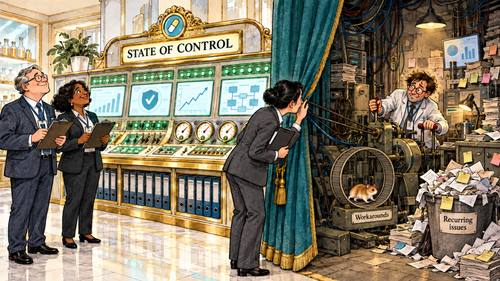
"Human in the loop" isn't automatically a control: Automation bias, cognitive ease (clean output feels truer), and review fatigue all wear down a reviewer's vigilance. His fixes are to limit review volume, use risk-based triggers, require written justifications instead of an "approve" button, rotate reviewers, and actually measure detection rates.
Be skeptical of the hype: He notes there's no truly self-validating "zero-touch" system yet, and "AI checks AI" only works if the models are genuinely independent.
How to start: Fix your requirements first, pilot AI on completed validation packages you already trust, qualify the tool for your intended use, and bring QA in from day one.
Why it Matters:
CSV is one of the most document-heavy, time-consuming parts of keeping GxP systems compliant. It's also where an AI-generated error can sit until an inspector finds it. Henrichmann gives Quality and Validation teams a practical, GAMP-aligned way to use AI where it's strong while redirecting human effort toward what actually protects data integrity. His idea that validation professionals will shift from "document managers" to "quality architects" also signals a real change in the skills these teams will need.
My Take:
This interview hits on something I bring up in every workshop: the psychological trap of reviewing AI output. Automation bias, cognitive ease, and review fatigue aren't new. It's the same thing that happens when you start giving a trusted, brilliant colleague's work a lighter review than you probably should. With AI, that dynamic gets amplified, and there's just so. much. more. output. If your only safeguard is "a qualified person looked at it," you're counting on vigilance under exactly the conditions that wear it down. I also love that he separates deterministic, checkable AI work from interpretive judgment calls. People tend to talk about "using AI for validation" as if it's one thing, and it isn't. A traceability gap check and an adequacy assessment carry very different levels of risk, and your review process should reflect that.
Source: Life Science Connect – Building Trust In AI For Computerized System Validation
Generative AI declaration: Heck yeah I use gen AI to brainstorm, draft, and edit my newsletter sections (would you even trust me if I didn’t?). My stories and phenomenal sense of humor are my own. However, if that bothers you, looks like you signed up for the wrong free newsletter and you are entitled to a full refund. -A
Get the next edition in your inbox
Clear, practical takes on what matters for your CMC, QA, and regulatory work, once a week.
No spam. Unsubscribe anytime.