AI for Lead Gen? Build a Workflow, Not Just a Prompt.
Love it or hate it, many of us in the life sciences need customers. Let's use AI to find them.
Hey friends,
I've been thinking a lot this week about a use case that I know a lot of people would benefit from, but aren’t sure how to go about executing it: using AI for lead generation.
Not the spammy, mass-email, "Dear [First Name]" kind. I mean the actual research-heavy work that goes into finding the right biotech or pharma companies to reach out to — the ones who actually need what you offer, right now.
If you're a consultant, a CDMO, a CRO, or anyone who sells services to life science companies, you know what I'm talking about. You spend hours digging through SEC filings, press releases, LinkedIn posts, and FDA databases trying to figure out which companies are at the right stage, have the right gaps, and might actually pick up the phone (or maybe you aren’t doing this, and just praying that they find you). The research is high-value work, but it eats your week alive.
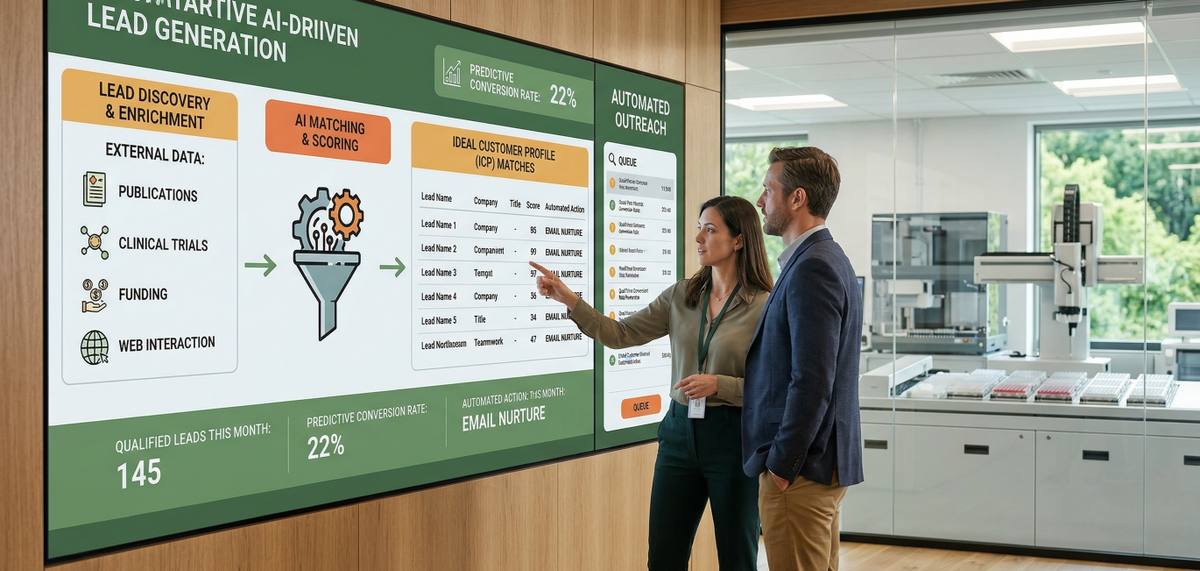
I personally have been experimenting with building AI workflows (not single prompts — workflows) to compress that research cycle. The key insight is the same one we keep coming back to in this newsletter: context is everything. If you tell an AI "find me leads," you'll get garbage. But if you give it a role, feed it your ideal client profile, and chain your steps together — identify trigger events, research the company's pipeline and regulatory stage, then draft a personalized outreach angle — the output is shockingly usable. At the very least, a strong starting point that would have taken you way too long to pull together manually.
For those of us starting out on a project like this, don't try to automate the whole BD process. Audit where you actually spend your time first. Pick the 3-5 tasks that feel like busy work versus high-value consulting, and start there. Prospect research and first-draft outreach messages are almost always good candidates. Relationship-building and judgment calls are not. You already know this instinctively — it's the same delegation framework we use for any AI use case.
And revisit your setup regularly. I had a workflow that was working great in January and by March the model had changed enough that I needed to retune my prompts. That's just the reality of this space right now. Set a monthly check-in with yourself, and get comfortable with the fact that stuff is always changing.
I think this is one of those areas where AI can be a real force multiplier for small teams and independent consultants in life sciences — the kind of people who don't have a BD department but still need a pipeline. Worth experimenting with if you haven't already.
Thanks for reading!
-Alexa
News
Benchling's 2026 Biotech AI Report
What's New: Benchling released their 2026 Biotech AI Report, surveying ~100 biotech and biopharma organizations that are actively using AI in R&D. The headline: AI's first "killer apps" in biotech have arrived — literature review (76% adoption), protein structure prediction (71%), scientific reporting (66%), and target identification (58%). But adoption drops sharply in more complex, regulated areas like generative design, biomarker analysis, and ADME, where data is messy and hard to validate.
How It Works:
The report surveyed U.S. and European scientists, technologists, and executives across discovery, process development, bioanalytical, and tox functions — all active AI users
The top AI wins share a common trait: clean, verifiable data that fits into existing workflows. That's why literature search and structure prediction took off first
Where AI stalls — complex workflows, scattered data, regulatory-heavy contexts — the bottleneck isn't the model, it's the data infrastructure
89% of scientists now use copilots or reasoning tools as their first stop when working with data
67% of AI talent is being built through internal upskilling, not hired from tech
Top areas of planned growth: workflow orchestration, manufacturing optimization, multimodal models, and AI "co-scientists"
Why It Matters: This report is one of the clearest snapshots of where AI actually works in biopharma vs. where it doesn't — yet. The pattern should feel familiar to anyone in CMC or QA: AI thrives where the data is structured and the outputs are easy to verify. It struggles where data lives in silos, formats are inconsistent, and validation requires deep domain knowledge. That's our world. The fact that manufacturing optimization and workflow orchestration are top growth areas tells me these teams are about to start looking downstream from discovery — toward process development, tech transfer, and quality. If you've been wondering when AI would start showing up in your part of the pipeline, this is the signal.
My Take: Two things jumped out at me. First, the 67% internal upskilling stat. That's not a tech-hiring story — that's a culture story. The companies winning with AI are investing in their existing scientists. Second, the report explicitly calls out that data infrastructure is the ceiling, not model capability. We've been saying this in CMC for years about our own systems. The models are ready. The question is whether our data is. If your organization hasn't started thinking about what "AI-ready data" looks like for batch records, stability data, or deviation trends — now would be a good time.
Source: Benchling 2026 Biotech AI Report
White House Releases National AI Policy Framework
What's New:The White House published its legislative recommendations for a national AI policy framework in March 2026. The document lays out seven priority areas where Congress should act, covering everything from child safety and IP rights to workforce development and federal preemption of state AI laws. Notably, it calls for no new federal AI regulatory body, favoring sector-specific regulation through existing agencies and industry-led standards.
How It Works:
The framework is organized into seven pillars: protecting children, safeguarding communities, intellectual property, free speech, enabling innovation, workforce development, and establishing a federal policy standard
On IP: the Administration believes AI training on copyrighted material doesn't violate copyright, but supports letting courts decide. It also suggests enabling collective licensing frameworks for rights holders
On innovation: recommends regulatory sandboxes, making federal datasets AI-ready, and relying on existing regulators (like FDA, EPA, etc.) rather than creating a new AI agency
On state preemption: proposes a federal standard that would override state AI laws deemed overly burdensome, but preserves states' rights to enforce general laws (fraud, consumer protection, child safety) and control their own AI procurement
On workforce: calls for integrating AI training into existing education and apprenticeship programs, and expanding AI programs at land-grant institutions
Why It Matters: This is a "set the table" document — it's telling Congress what to build, not building it. But it signals direction, and two sections stand out for our world. First, the "no new regulator" stance means FDA stays in the driver's seat for AI in pharma and biotech. Your AI tools in CMC, QA, and regulatory submissions will continue to be governed by existing frameworks like 21 CFR Part 11, Annex 11, and ICH guidelines — no surprises there. Second, and what I think is underappreciated: the framework explicitly calls for AI workforce education and small business support. We're talking about integrating AI training into existing education and apprenticeship programs, expanding programs at land-grant institutions, and providing grants, tax incentives, and technical assistance to help small businesses adopt AI. Our industry runs on CDMOs, contract labs, and specialty manufacturers — a huge number of which are small-to-mid-size businesses. If Congress follows through, this could be a real growth lever for the companies many of us work at or with every day.
My Take: The workforce and small business pieces are what excite me most here. Right now, AI literacy in life sciences is largely self-directed — people figuring it out on their own or through a handful of programs (like this one!). If AI training gets baked into the education and apprenticeship pipelines that feed our industry, that changes the game. It means the next generation of quality engineers, regulatory associates, and process scientists could arrive with a baseline AI fluency instead of starting from scratch. And for smaller organizations that can't afford dedicated AI teams, grants and technical assistance could be the difference between adopting AI and watching from the sidelines. The framework itself won't change your day-to-day, but keep an eye on the legislation that follows from it.
Source: White House National Policy Framework for AI — Legislative Recommendations (PDF)
Get the next edition in your inbox
Clear, practical takes on what matters for your CMC, QA, and regulatory work, once a week.
No spam. Unsubscribe anytime.