AI literacy and getting hired right now
How important is AI tool proficiency when looking for a new role?
Howdy friends,
Earlier this month I got an interesting call from a good friend who was beginning to casually-but-maybe-not-so-casually start looking for a new role outside of their current one. This person has very impressive expertise, and not in a LinkedIn bot "I was very impressed by your background blah blah blah let me waste 5 more seconds of your life before you close this window" way. Decades of it, highly specialized, trusted by countless big pharma leaders for knowing what they know and for offering insight on topics that others happily pay for. So when they asked me for recommendations on AI literacy training, I was intrigued.
I've known them for years, so naturally my first question was… you know this is like, what I do, right? Why now? What was the driving force to finally hitch a ride on the ol' AI-augmented-professional bandwagon? They had a simple enough answer: it felt like every other job posting out there in the industry mentions basic AI skills and/or familiarity with generative AI tools.
And yes, this makes total sense to me, a person who is neck-deep in daily AI news and where it intersects with the life sciences industry. But my message has usually been "get out in front of it now, because you will need it," and not exactly "you need it to get hired today." So how strong is the correlation between AI literacy and getting hired right now? I decided to have Anthropic's Fable (and for comparison GPT-5.6 Sol Pro) take a crack at running the numbers, and you can read the full report here. The download is the Fable report; Sol had some similar conclusions but I liked the writeup less.
I wanted to see what the estimates said about AI literacy across all jobs, knowledge workers, and our own industry. Many of the conclusions were not surprising (job postings mentioning AI have climbed to an all-time high), but some definitely made me raise an eyebrow or two (employers saying they got burned making "bad AI hires" from people overselling their AI competency on a resume).
Here's the short version.
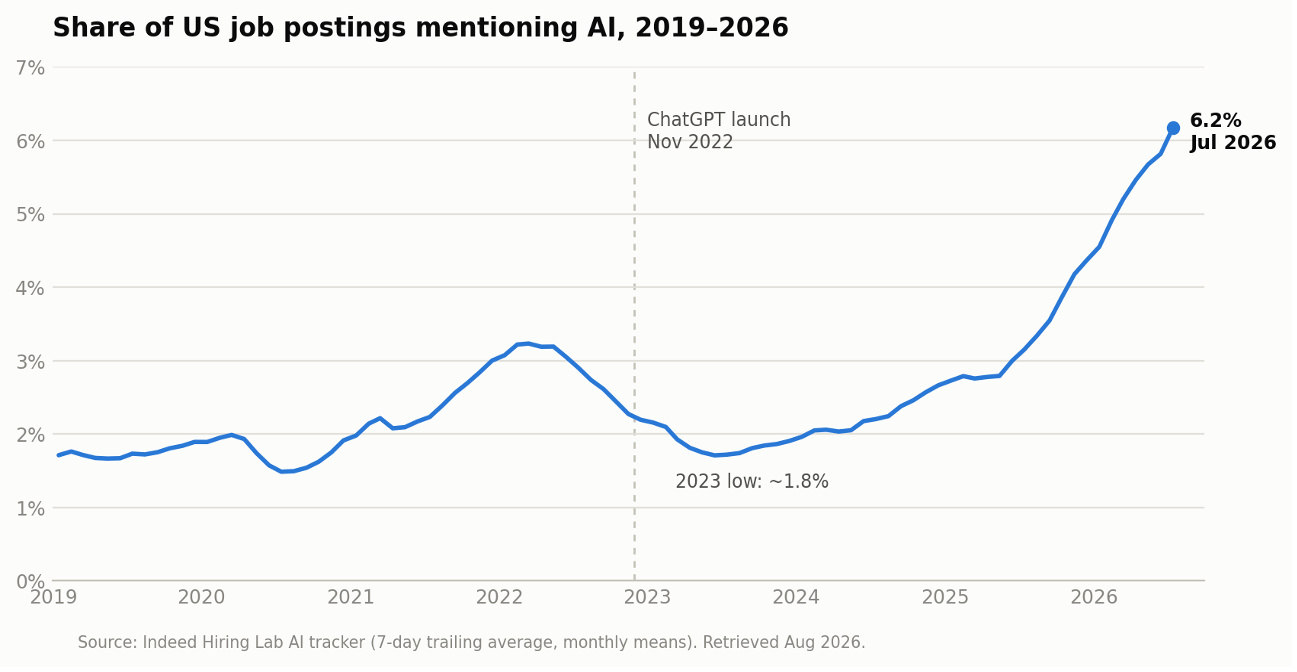
The share of US postings that mention AI roughly tripled in three years, from about 1.9% on average in 2023 to 6.2% this past July. I’d say that’s probably noticeable to someone who hasn’t been on a job hunt in several years.
But if we dig into this number a bit more, 6% is likely an underestimate of true employer expectation. Roughly 1% of employers write about 90% of the AI-specific postings, and plenty of hiring managers expect AI fluency without mentioning it in the job requirements. Ask them directly and the numbers go up. ZipRecruiter's 2026 employer report has 74% calling AI skills a strong advantage or a strict requirement, with half expecting a new hire to already be a practical user on day one. In TestGorilla's survey, 53% of hiring managers said they'd take a candidate with high AI fluency over one with deeper domain expertise. This is another one that made me go “whaaaaaat?”
When we talk about pay, it looks like it is moving the same direction. PwC puts the wage premium for workers listing AI skills at 62%, up from 56% last year and 25% in 2024. Lightcast, measuring posted salaries instead of worker wages, shows 28%. Different methodologies but both figures clearly increasing.
What about after the offer is made? Fifty-nine percent(!) of organizations report making a bad AI hire, someone who interviewed beautifully on AI and then couldn't deliver, and only 26% currently ask candidates to demonstrate AI use with verified results. I’d take this as a very strong signal that you can see where hiring is headed, which is toward practical assessments, work samples, and "walk me through what you did" questions. Listing ChatGPT under Skills is about to be worth roughly what listing Microsoft Word was worth in 2010.
Then there's our neck of the woods. AI-related job growth in health industries (which is way more than just pharma/biotech) came in under 1% for 2026, against 11% in tech and media, so on paper we look like the sector where someone might say, “meh, it’s not such a big deal”! Look at the hiring side though, and about 70% of pharma hiring managers say they can't find candidates who bring both the science and the AI competency, specialized AI roles take four to six months to fill, and 49% of pharma professionals name missing digital skills as the top barrier to their own company's transformation.
Usual caveats apply to this report. The survey numbers come from vendors who sell hiring and assessment tools, the wage premiums partly reflect the fact that AI-heavy firms paid above market even before AI, and posting data leans toward large employers. Even by reading this newsletter, you know that I sell AI literacy and fluency courses. So draw your own conclusions of course, but I'd bet on at least the trajectory of every finding here.
So bottom line message to current job seekers:
Can you get hired today without knowing how to effectively use AI tools? Sure.
Might you find it more challenging if going up against a similarly qualified domain expert who can also demonstrate AI proficiency in related workflows? Abso-tootley.
No need to despair though.The bar for "competent" is not out of reach. Plus, it’s a skill that can be fully self taught, though it requires some discipline. The fastest way to get there is doing real work with the tools in your own function, but what potential employers want to see is not that you can get a chatbot to give you answers, but you have a strategy and process for getting results that can move the needle at work.
Turns out, that's the part I can help with…
I'm once again running an AI Literacy Bootcamp built for people working in life sciences, starting in September.
It's for anyone with deep expertise, real credibility, but no structured way to build AI capability that stands up in a regulated environment. We work with the tools on the kind of documents and questions you actually handle, cover verification strategy, and get you to the point where you can be proud to show your work and avoid just listing “uses ChatGPT” on your resume.
Seats are limited so we can keep it hands-on. If you're on the fence, send me an email at alexa.kopf@labscaleai.com and tell me what you're working on and what your goals are.
Thanks for reading!
-Alexa
News
AI in GMP Right Now, According to the People Doing It
What's New: A3P's La Vague n°91 ran a practical survey by Lionel Pelletier of AI in GMP environments, and it's one of the more grounded pieces on the subject. The framing is that the debate has moved on: the question is no longer whether machine learning or language models can be used in manufacturing and QC, but under what conditions they can be considered compliant and under control. The article walks through the use cases already running today, lays the European and U.S. regulatory approaches side by side, and gets into the part most people skip, which is what you actually have to build and maintain to defend one of these systems in an inspection.
How It Works:
The use cases already in production are less glamorous than the headlines. Automated visual inspection has used ML for years to catch defects and cut false negatives. Predictive maintenance runs off sensor data (vibration, temperature, pressure, consumption drift) to head off unplanned downtime. QC labs use it for chromatographic peak integration, microscopy image classification, and trend analysis across test series.
The newer LLM use cases are the ones landing in quality: help handling deviations, drafting and summarizing annual product reviews and trend reports, and guided search across document repositories.
The agencies are running their own. FDA has ELSA, EMA has Scientific Explorer and Regulus, and A3P has its own regulatory intelligence tool, RING.
Europe is system-centric. The AI Act (EU 2024/1689) tiers systems by risk and brings requirements for transparency, traceability, risk management, human oversight, and AI literacy. On top of that, a dedicated GMP Annex 22 is in development, with Chapter 4 (documentation) and Annex 11 (computerized systems) under revision alongside it. The circulated working drafts lean toward static, deterministic models and express reservations about probabilistic models, generative AI and LLMs specifically, for critical GMP applications.
The U.S. is output-centric. FDA's draft guidance builds around a credibility assessment, where credibility isn't a property the model has, it's something you demonstrate for one specific context of use. The evidence required scales with how much influence the model has over the decision and what happens if that decision is wrong.
The January 2026 FDA–EMA joint guiding principles give both sides a shared vocabulary: human-centered design, a risk-based approach, a clear context of use, multidisciplinary expertise, data governance with traceable provenance, risk-based performance evaluation that accounts for human-AI interaction, lifecycle quality management, and clear information for users.
What you validate is the system, not the model. Sensors, data acquisition, preprocessing, the model, the interface, the decision rules, and the records all come along, and the documentation ends up looking like a justification dossier: intended use, data and acceptance criteria, evaluation results, risk analysis, and the monitoring strategy.
Pelletier's six operational levers: an "AI GMP" dossier per use case, documented data lineage with versioned datasets, configuration control covering model, parameters, code and runtime environment, a test strategy that includes edge cases and non-regression testing after every change, routine monitoring wired into the QMS with alert thresholds, and training that runs both directions (quality staff on AI limitations and bias, data teams on traceability and change control).
Why It Matters: The usual cause of failure isn't the algorithm, it's never having written down the intended use. Everything downstream depends on it. Criticality classification (does this thing prioritize a deviation investigation, or does it adjust a process parameter in closed loop?) sets your evidence level and how much human oversight you need. Data governance stops being a nice-to-have because provenance, representativeness, and bias in the training set are what the model's credibility rests on. Drift is the failure mode that has no bug report attached to it, since a new sensor, a new supplier, or a new formulation can degrade performance with nothing visibly broken, which is why change control and defined decommissioning criteria belong in the plan from the start. And the Annex 22 posture on generative models is the thing to watch, because the LLM-in-quality-workflows use cases spreading fastest right now are exactly the ones the drafts are most cautious about.
Source: A3P, La Vague n°91 — Artificial Intelligence in GMP Environments: Where Do We Stand? (July 2026) | Full issue PDF
Five Asia Pacific Regulators, Five Different Answers on AI
What's New: ISPE's Regulatory Quality Harmonization Committee sent its Asia Pacific Regional Focus Group through the recent AI guidance coming out of the region, and published the results as an iSpeak post on August 13. The tour covers Australia, ASEAN, Singapore, South Korea, and China. The short version is that the region is not moving as one: some markets are still at the level of principles, others have gone straight to building AI into how the agency itself reviews, inspects, and monitors. The group's own read is that this divergence is temporary and that Asia Pacific will converge toward the US and EU position over time.
How It Works:
Australia treats AI as a critical technology under a National AI Plan organized around capturing the opportunity, spreading the benefits, and keeping Australians safe. The device framework is technology agnostic, so what determines regulation is the intended purpose the manufacturer defines, not whether AI is under the hood. TGA expects manufacturers to watch how updates change functionality and to hold off on anything that shifts intended purpose until it clears approval. Synthetic training data is allowed with a documented rationale, though TGA notes it may lack the depth and variability to validate a product, and is less likely to fly where real data exists in volume.
ASEAN published a Guide on AI Governance and Ethics in 2024, written collaboratively across member states as a living document. Seven principles: transparency and explainability, fairness and equity, security and safety, human-centricity, privacy and data governance, accountability and integrity, and robustness and reliability. It also gives organizations four components to build a governance framework around, including deciding the level of human involvement in AI-augmented decisions, plus a risk impact assessment template and six regional use cases.
Singapore works on two levels. IMDA issued cross-cutting frameworks including a Model AI Governance Framework for Agentic AI, which puts humans as ultimately accountable for what agents do. MOH and HSA jointly issued Artificial Intelligence in Healthcare Guidelines in March 2026. Neither regulates pharmaceutical manufacturing, but HSA's lifecycle guidance for software and ML-enabled medical devices is the one worth reading anyway, since it names the AI-specific risks in manufacturing terms: degradation over time, false negatives letting quality issues through, false positives triggering unnecessary batch rejections, and retraining or data changes disturbing established process knowledge. The framing to sit with is that inspectors will expect an explanation of why the model's outputs can be trusted rather than a demonstration that the system runs as designed.
South Korea's MFDS has moved from pilots to systemic integration, per its 2026 Work Plan. AI risk prediction for imported food inspections, a real-time monitoring system for illegal online drug sales and fake practitioner endorsements, and an integrated monitoring system for narcotics misuse. The number pharma will care about: MFDS is targeting a cut in drug approval review time from 420 days to 240 using an AI review support system. This sits on top of the Digital Medical Products Act enacted in January 2025 and earlier 2023 guidances on clinical trial design and approval for AI-based medical devices.
China's NMPA issued Implementation Opinions on AI and Drug Regulation on April 2, 2026, laying out an integrated drug regulation and AI system by 2030 across seven focus areas. Human-machine collaborative review and approval, supervision spanning R&D through post-market distribution, data-driven risk signal detection from complaints and online sales, a smart drug testing system involving robotics, and a risk-based inspection platform that builds inspection plans from big data on a company's audit history, using AI to set inspection targets and frequencies. The stated vision runs to 2035.
The conclusion points at the plumbing that will force the issue: structured content authoring, FDA's KASA, and the ICH M4Q(R2) shift from document-based to information-based submissions, all of which push toward digital tools and the supervision of them.
Why It Matters: Almost nothing in this roundup is a GMP regulation. It's national AI policy, medical device software guidance, and agency modernization plans, which means a QA or regulatory professional reading it will not find a clause to comply with. If you’ve been in the game long enough, you know that expectations in this industry tend to arrive through what the agency does internally long before they show up in a manufacturing annex. The China and Korea items describe agencies putting AI on their own side of the table, where a risk-based inspection platform built from audit history means your filing and inspection record becomes a live input into how often someone comes to see you. For anyone with product registered across these markets, the practical near-term consequence is that "our AI approach" stops being one answer and starts being several, with the same underlying evidence needing to satisfy a technology-agnostic intended-purpose test in Australia, a lifecycle-and-monitoring test in Singapore, and a rapidly automating review process in Korea and China.
Get the next edition in your inbox
Clear, practical takes on what matters for your CMC, QA, and regulatory work, once a week.
No spam. Unsubscribe anytime.