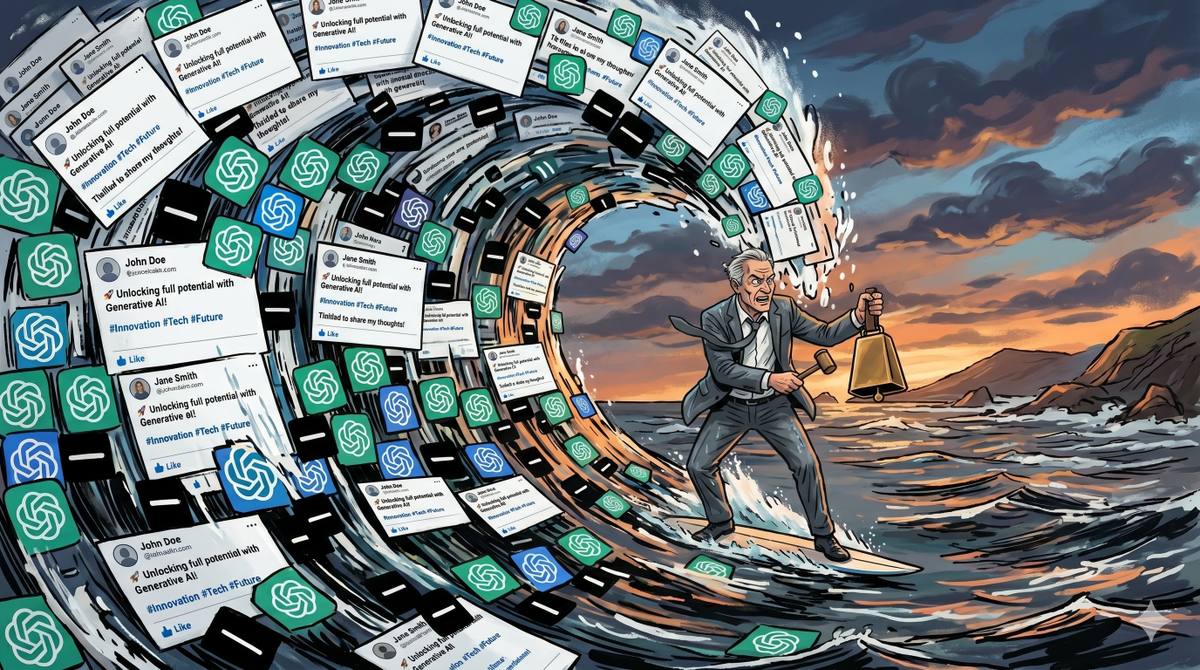
I have a fever, and the only prescription is more cowbell (I mean AI)
No really, AI writing is so bad because people don't use it enough.
Hey friends,
If you've so much as glanced at social media in the last few months, you've been slapped in the face by the AI-slopocalypse. It's everywhere. And it's mostly being driven by people who recently discovered AI tools and figured the easiest possible use case was generating social posts, newsletters (ahem), and website copy.
Obviously, everyone is noticing that it all sounds the same. And when that happens, it viscerally bothers other humans.
I think there are a few reasons. The main one being the layer of mistrust we get when we know AI obviously had a hand (or whatever the computer-version of a hand is) in drafting something — we can no longer trust that the person who posted it is really the expert. They probably are, unfortunately. But they've hurt their credibility by letting AI speak for them in its all-too-recognizable robot voice.
We have been quick to forget that for a lot of people, writing is hard. It takes effort. Most of us aren't "good" at it, because writing isn't a skill we developed as adults, for whatever reasons. At the same time, society has decided to put a ton of extra value on people who can write well (books, website copy, social posts, resumes, and yes... newsletters), and it shouldn't really be like that. These things used to get outsourced to people who were good at writing, to represent people who weren't (and that was totally OK for some reason). People get jobs based on the quality of a resume, and get mad when AI is used to write a resume — but does anyone really stop to think about why they're mad about that? Unless the job is for an expert resume writer, it shouldn't factor in at all. It's actually kind of ridiculous.
I'm less emotionally affected by AI slop than most people seem to be, probably because I understand that we'll get through this grossness. The medicine for AI slop is to use AI MORE for drafting. What the heck do I mean by that? Slop is born of AI newness, and there are too many new users right now. One day, they will not be new. They will have found their voices. They will have figured out how a person should actually be writing with AI. And this will all feel like a bad dream.
Writing, individuality, and being human have all been intertwined since our ancestors started scratching things on cave walls. Now most things sound the same, and it's hurting our collective feelings.
So if you're one of my readers who may — even unknowingly — be a source of internet AI slop, here are some tips:
1. Put more of YOU in the prompts. Say everything you want to say. Get it all out there. Give your point of view, your opinion. Make sure it's useful, not noise. If you're stuck writing one-liner prompts like "write a LinkedIn comment about this other person's post," resist. You ARE the slopocalypse. Stop it.
2. DON'T stop using AI. Use it a lot more. For a lot more writing things. They don't all have to go on the internet. Just like LLMs, humans are excellent pattern recognizers in written text. Eventually you'll start to see it better. It might begin to make you cringe. Good. Take the cringy parts out. Change the words.
3. Don't be afraid to just type sometimes.
4. Take it easy on the people who haven't figured it out yet — because none of us really have. Some are just a little further along, and we should be encouraging each other.
Thanks for reading!
Alexa
p.s. my sincere apologies to my younger readers who don’t get the cowbell reference, and I beseech you to google it.
News
OpenAI Drops GPT-Rosalind, a Frontier Reasoning Model Built for Life Sciences
What's New: OpenAI launched GPT-Rosalind on April 17, a purpose-built reasoning model for biology, drug discovery, and translational medicine. Named after Rosalind Franklin, it's available as a research preview in ChatGPT, Codex, and the API for qualified Enterprise customers under a "trusted access" program. It's not a general-purpose chatbot — it's optimized for scientific workflows like evidence synthesis, hypothesis generation, and experimental planning. Launch partners include Amgen, Moderna, Thermo Fisher, the Allen Institute, and UCSF School of Pharmacy. In an evaluation with Dyno Therapeutics on unpublished RNA sequences, the model ranked above the 95th percentile of human experts on prediction tasks and the 84th percentile on sequence generation.
How It Works:
Frontier reasoning model fine-tuned for chemistry, protein engineering, and genomics
Ships alongside a free Life Sciences research plugin for Codex that connects to 50+ scientific tools and databases (human genetics, functional genomics, protein structure, biochemistry, clinical evidence)
Available only through a "trusted access" program with eligibility review — restricted to U.S. Enterprise customers conducting "legitimate research with clear public benefit," with governance and misuse-prevention controls required
The plugin (the 50+ tool integrations) is more broadly available and works with mainline OpenAI models, even for orgs that don't get GPT-Rosalind access
What’s going on: This is the first time OpenAI has shipped a model specifically governed and gated for biological misuse risk — a meaningful precedent for how frontier labs are starting to treat life sciences differently than general productivity. For CMC/QA/Regulatory, the more interesting near-term piece is actually the Codex plugin, not the model itself. A standardized orchestration layer that connects to 50+ scientific databases is the kind of thing that, once normalized, will start showing up in regulatory and clinical evidence workflows too — not just discovery. Also worth noting: Joy Jiao, OpenAI's life sciences research lead, was careful to frame this as helping researchers move faster, not as AI creating treatments on its own — and reminded that no fully AI-discovered drug has cleared Phase III.
My Take: The trusted-access deployment is the part regulatory professionals should be paying attention to, not the benchmark scores. OpenAI is essentially saying we don't trust the open internet with this model, which is a tacit acknowledgment that biological reasoning capabilities have crossed some threshold.
Source: Introducing GPT-Rosalind for life sciences research — OpenAI
Amazon Launches Bio Discovery, Its Own AI Drug Discovery Platform
What's New: Three days before GPT-Rosalind, AWS launched Amazon Bio Discovery (ABD) on April 14 — an agentic application that combines computational design and wet-lab validation in one place. It ships with 40+ biological foundation models (bioFMs), AI agents that help non-computational scientists run experiments through natural language, and integrated CRO partnerships with Twist Bioscience, Ginkgo Bioworks, and A-Alpha Bio for direct wet-lab validation. A Memorial Sloan Kettering project using ABD designed nearly 300,000 novel antibody molecules and sent the top 100,000 to Twist Bioscience for testing — a process that typically takes up to a year, completed in weeks. Early adopters include Bayer, the Broad Institute, Fred Hutch Cancer Center, and Voyager Therapeutics.
How It Works:
Catalog of 40+ AI biology models including open-source and commercial models from partners like Apheris and Boltz
AI agents walk scientists through model selection, hotspot residue identification, framework selection, and candidate scoring — all via natural language, no coding required
"Recipe" workflows: computational biologists build reusable pipelines, bench scientists configure and run them — embedding computational expertise in shareable workflows
Lab-in-the-loop: results from CRO partners flow back into the platform automatically, fine-tuning models with each cycle
Built on the same AWS infrastructure already used by 19 of the top 20 pharma companies
What’s going on: ABD and GPT-Rosalind are now competing for the same workflow from opposite directions — AWS is leveraging its existing pharma infrastructure relationships, OpenAI is leveraging frontier model capability. Pharma companies will almost certainly run multi-vendor strategies; the real question is which platform earns enough trust in specific high-value tasks to become the default. For QA and Regulatory, ABD is interesting because it's explicitly built for non-computational users — meaning bench scientists can now run sophisticated AI-driven design workflows without a computational biologist in the loop. That's a governance question your quality program needs an answer for, and "we don't do drug discovery" isn't necessarily going to be the right answer for long, since the same UX pattern (agents + recipes + integrated downstream services) is what the next wave of regulatory and CMC tools will look like.
My Take: The MSK case study (a year compressed to weeks for antibody design) is the headline number, but the more durable story is the workflow pattern: agentic AI + reusable recipes + tightly integrated downstream services. That same pattern will eventually show up in regulatory writing, CMC documentation, and quality investigations — not just discovery. The teams who get good at evaluating these workflows now (which models, how they were validated, what the human-in-the-loop checkpoints are) will be in a much better position when this shows up in their own functions.
Get the next edition in your inbox
Clear, practical takes on what matters for your CMC, QA, and regulatory work, once a week.
No spam. Unsubscribe anytime.