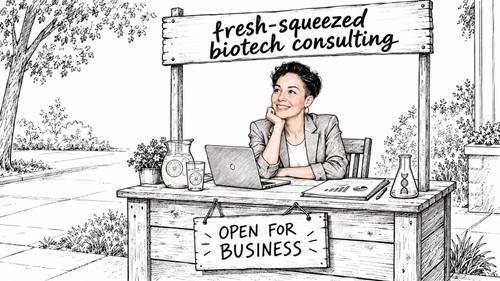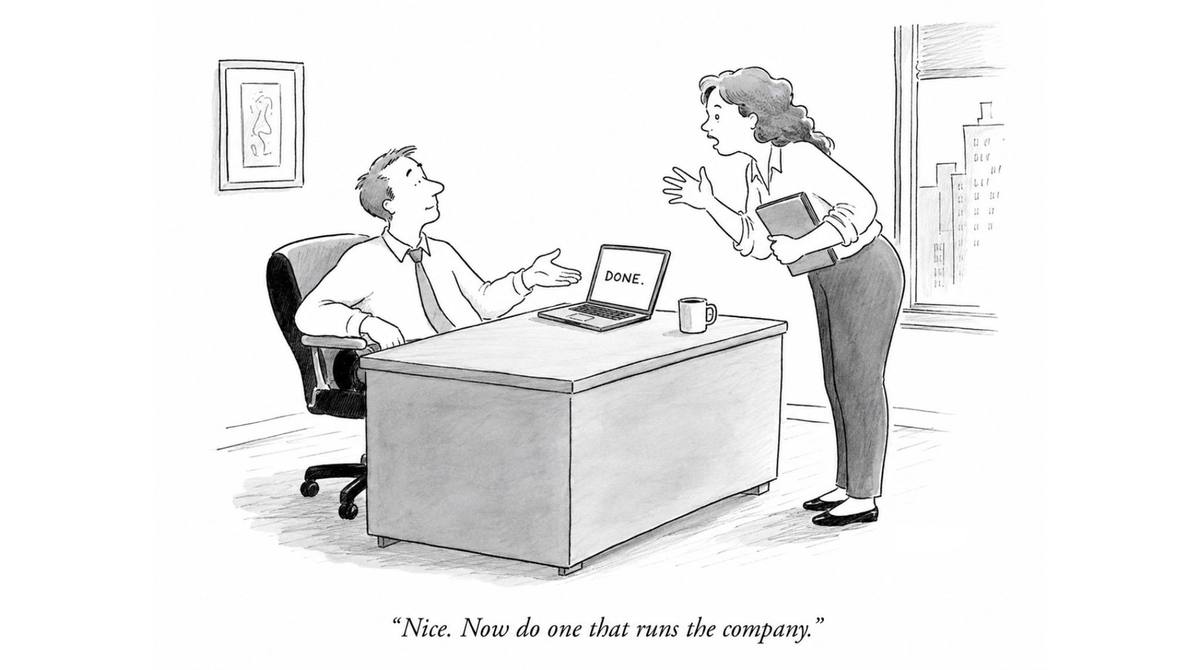
When AI gets boring, you're doing it right
Lukewarm take: the goal shouldn't be AI that blows your socks off. It's AI so woven into your work you forget it's there.
Hey friends,
Before I get into this week's newsletter, I wanted to let you all know that I'll be at BIO with my CMC consulting firm BDO in San Diego next week, June 22–25. If you're there too, you should definitely come by booth #5516 to say hi, catch up, or nerd out on AI stuff, because I'm always down for that. I'll also be speaking on Tuesday the 23rd in the Bioprocess Theater around 3:30. I don't think there's anyone out there who loves the sound of my own voice quite like I do, but it should still be a good and hopefully insightful session.
Now, on to this week's newsletter.
Last week I wrote about how the map is being redrawn faster than any of us can keep up with — reviewers, examiners, and peer reviewers all getting augmented at once, and the patterns we'd spent decades calibrating against suddenly going soft. That note ended on a slightly uneasy question: if the trail keeps shifting, what do we actually do about it? This week is a bonus add-on to that answer.
In the tiny realm I've worked in for the past decade — CMC, QA, and Regulatory — the most capable domain experts have wired the predictability of each side of their processes right into their brains. Back when I was a batch record writer at a tiny 50-employee boutique CDMO, I figured out fast that the quickest way to become known as the best batch record writer was to really get to know how the batch record reviewer in QA did things. We had one master reviewer, and she had an uncanny knack for it. My nickname for her was "eagle eyes" — she could catch every stray comma, period, and errant space, on top of a sharp understanding of manufacturing processes that were unique to every single client. Batch failures were almost nonexistent, and I credit most of that to the quality of the instructions handed to operators each week. It was that push/pull between tech writing and QA that kept everything running smoothly, and over time it became less about how well I could write instructions and more about how the two of us could thread the needle of our systems to get to the goal: successfully released clinical batches, right on schedule.
So when one or both sides of a symbiotic relationship like that gets an injection of seemingly supernatural capability, it makes sense that things get knocked off-kilter. Zoom out to every company, every agency, and every consultant in the world, and it can start to look like chaos. We get comfortable in the predictability, but it turns out each of us, as individuals, is pretty limited in the knowledge we can collect over a lifetime — at least compared to anything AI is working with.
That idea might give you anxiety, or make you a little sad, or maybe it excites you. Maybe all three. (For the record, I'm not immune to any of it either.) But I'd like to make a prediction, which is generally a terrible idea in this field: AI will become boring, and that's actually the goal.
Our jobs will shift, the way they always have with technology. Our roles will take on new and different responsibilities, and AI will just be — normal work. Remember when email was exciting? What about spreadsheets? Those things, along with countless others, fundamentally changed how all work got done. And it wasn't until they became boring (though I'll admit messing with my personal spreadsheets is still a weekend hobby) that the magic actually happened and the technology started to matter. The same arc is coming for AI. The people who've managed to fold it into their work with zero fanfare — to the point where they hardly notice it anymore — are most likely the ones seeing the biggest gains. And that's a total snoozefest.
I want to be clear that this is very different from people using AI without thinking, or without understanding the risks that come with it for regulated work. The real superusers have already done that work — they've scoped where it fits, set their data boundaries, and built the verification habits that make the output trustworthy (this is the whole ALIGN thing I keep going on about). The boring part comes after all of that, not instead of it. So when people ask what I do with AI in my consulting work, there's a nonzero chance they lose interest, because the honest answer is that I'm extending a skillset I already had and still doing a fair amount of "normal" work. I still type these newsletters with my own fingers on a keyboard, mostly out of personal preference — but that doesn't mean AI isn't in every intermediate step where it fits nicely.
The hype still has a place, though, because it's what brings people into the fold in the first place. It's so exciting that it pulls people in. The catch is that someone gets their first taste — armies of agents, the one-person billion-dollar company — and says "I want that," when the reality on offer is more like: what if you just shortened how long your Tuesday tasks take? Less of a sock-blower, but you get your afternoon back.
As Professor Ethan Mollick puts it, AI has a "jagged frontier" — earth-shattering in some places, useless in others. Almost nobody outside the very front of that frontier has any idea how wild it's gotten out there, while a surprising number of people still think the whole thing is hype that's about to fizzle. Both can't be right, and I'm always a little stunned by how many folks are in that second camp. You don't have to live at the frontier — most of us are hanging out near the back, and that's totally fine — but everyone should at least know which direction it's moving.
So here's the nudge to take into your week: go be so good at using these tools that it becomes boring. That's the flex.
Thanks for reading!
Alexa
News
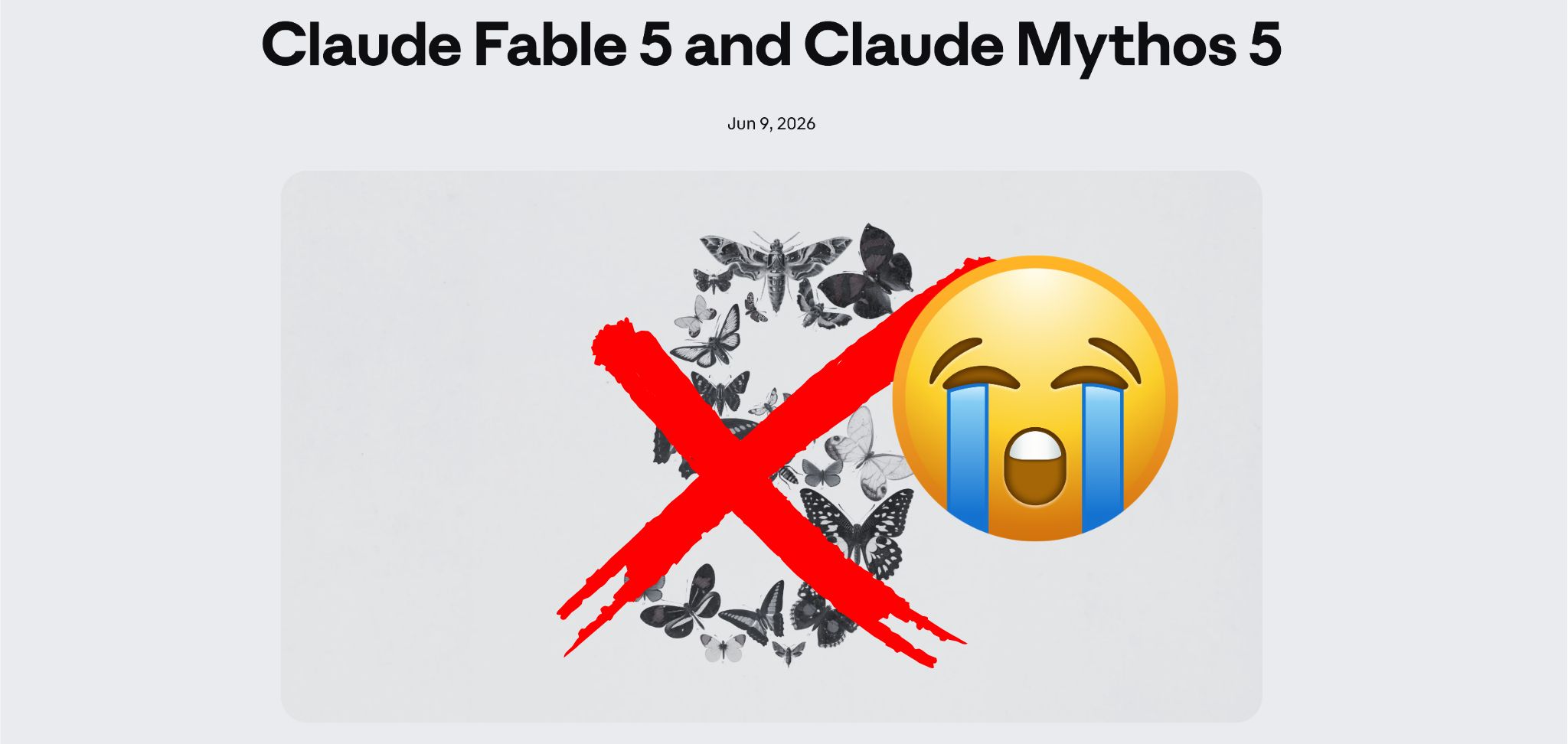
Anthropic Pulls Fable 5 and Mythos 5 After Government Directive
What happened: On June 9, Anthropic released two new top-tier models: Fable 5 (public) and Mythos 5 (restricted to a small set of research partners). Three days later, (also the day I shipped my last newsletter getting all excited about it) the government ordered them both offline.
June 9 — Fable 5 and Mythos 5 launch.
June 12, 5:21pm ET — Commerce Secretary Howard Lutnick sends a letter to CEO Dario Amodei citing an export control directive under national security authorities. It instructs Anthropic to prevent all foreign nationals from accessing the models — including foreign nationals inside the US, and Anthropic's own non-citizen employees.
Same day — Because Anthropic cannot filter foreign nationals from US users in real time, it disables both models for all customers to ensure compliance. Access to its other models, including Claude Opus 4.8, is unaffected.
The stated concern: the government's understanding that someone had found a method of "jailbreaking" Fable 5. Anthropic disputes the severity, saying the technique essentially consists of asking the model to read a specific codebase and fix software flaws, and that the same capability is widely available from other models including OpenAI's GPT-5.5. The company is complying while stating it believes this is a misunderstanding and it is working to restore access.
Current status: As of June 19, both models remain offline, and no official restoration announcement has been made. All other Claude models stayed online throughout.
My Take: Expect more of this, not less. As these models get more capable and more entangled with national security questions, the odds of a launch getting yanked, restricted, or paused go up, not down. The practical lesson isn't to panic, it's to avoid getting too dependent on any single AI provider or model. What you have access to today can disappear in an afternoon, with three days' notice or none. That said, this shouldn't slow anyone down on learning the tools themselves. The skill of working well with AI transfers across providers; the specific model does not.
Source: Anthropic statement | CNBC | Fortune
FDA Accepts Its First AI In-Silico Drug Development Tool
What's New: On June 3, FDA's Center for Drug Evaluation and Research (CDER) accepted the first Letter of Intent for an in silico drug development tool (DDT) into the Innovative Science and Technology Approaches for New Drugs (ISTAND) Qualification Program. The tool is an AI-driven digital liver model for predicting Drug-Induced Liver Injury (DILI).
How It Works:
The model predicts DILI by leveraging AI to compare the chemical structures of new drug candidates against historical reference drugs with known DILI risk. It targets small molecule new drug candidates, and if qualified, would complement existing preclinical data to support decision-making before phase I trials.
Predictions are meant to complement other DILI risk-assessment methods as part of a weight-of-evidence approach — not replace them.
It's classified as a New Approach Methodology (NAM), aligning with CDER's investment in the 3Rs (replacement, reduction, refinement) of animal testing.
Acceptance is the first of a three-step qualification process: the LOI is followed by a Qualification Plan, then a full qualification package. Only after successful qualification can sponsors use the tool within its specified context of use.
ISTAND exists for tools that don't fit established evaluation pathways, such as biomarkers and clinical outcome assessments.
Why It Matters: DILI is one of the most significant safety concerns in drug development and a leading cause of clinical trial termination and drug attrition during the IND process, and the FDA notes current modeling does not accurately identify DILI risk in humans. If this tool clears qualification, it sets precedent for how computational and AI-generated evidence earns a defined, repeatable place in a submission — a context of use, a weight-of-evidence role, a qualification trail. For anyone in CMC or preclinical, that's the shape of things to come: not AI as an unofficial shortcut, but AI-generated evidence with an actual regulatory pathway behind it.
Source: FDA CDER Statement
Get the next edition in your inbox
Clear, practical takes on what matters for your CMC, QA, and regulatory work, once a week.
No spam. Unsubscribe anytime.